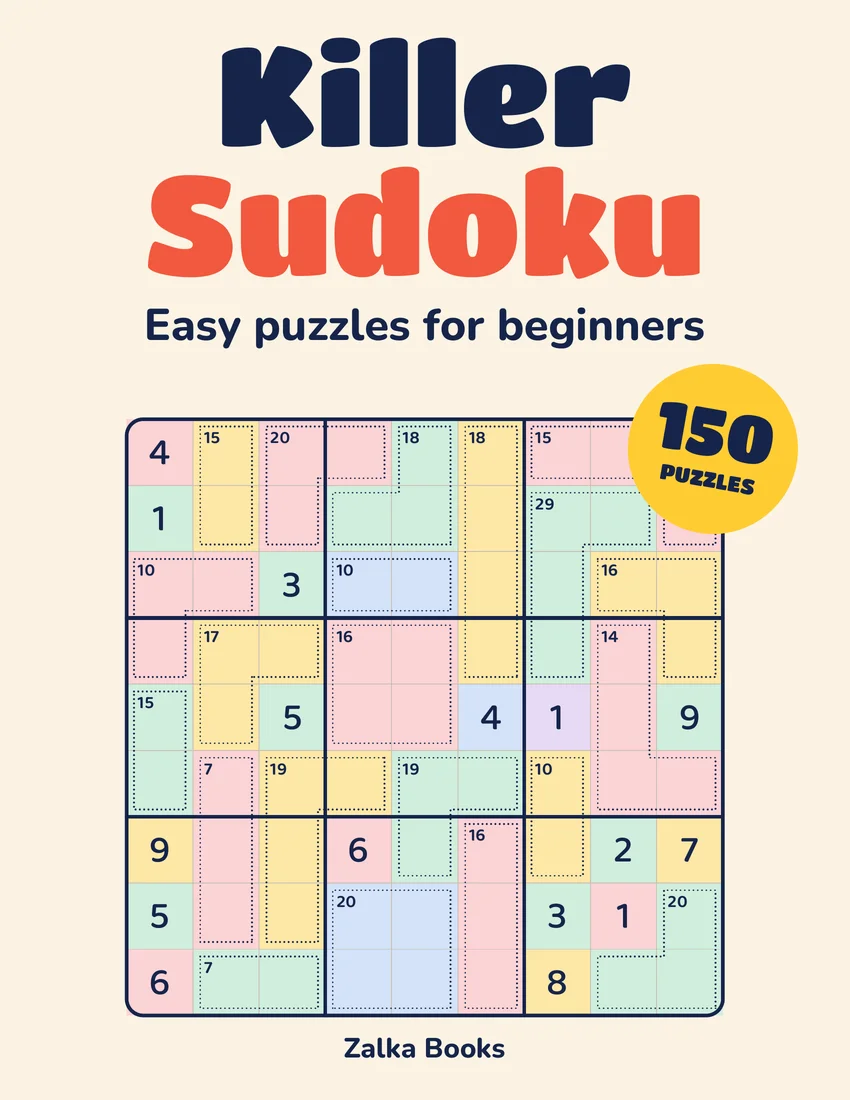
What is Killer Sudoku? The rules, the rule of 45 and how to start
It sounds dangerous, but nobody gets hurt. Except maybe your pencil.
If you've been solving Sudoku for years and the grids have started to feel the same, Killer Sudoku is a great next step. The rules of ordinary Sudoku stay exactly as they are, and one new rule is added – and that one rule makes you think in a completely different way.
The rules
Killer Sudoku has two rules.
The first one is old. Fill in the digits 1 to 9 so that every row, every column and every 3×3 box contains each digit exactly once. Just like ordinary Sudoku.
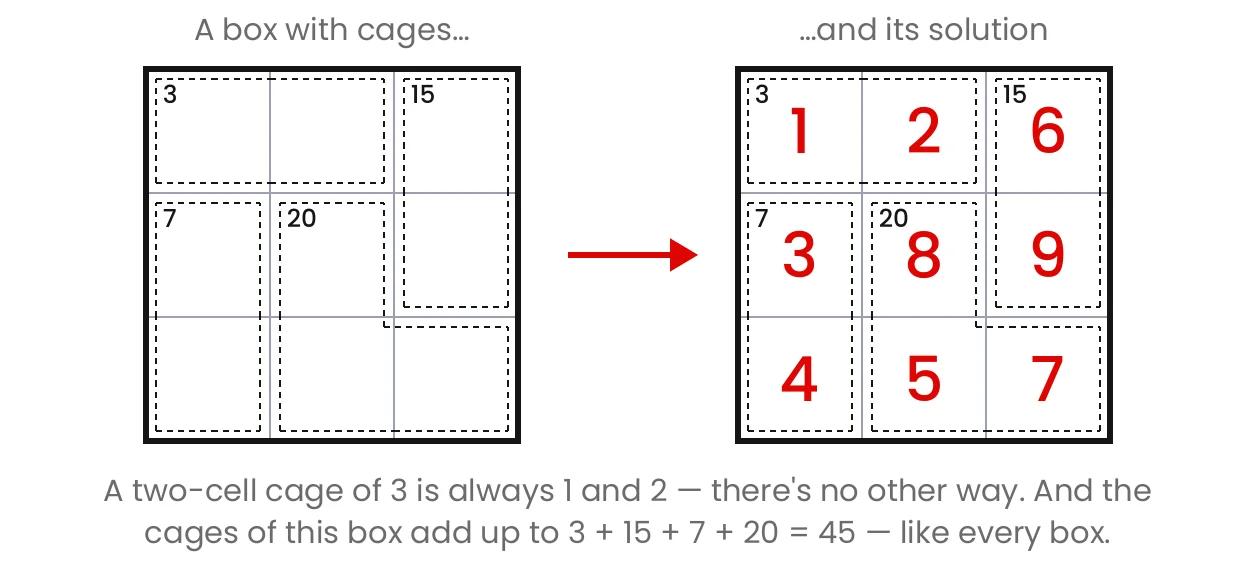
The second one is new. The grid is divided into cages – areas outlined with a dashed line. Each cage has a number in its corner. The digits in a cage must add up to that number, and no digit may repeat within a cage.
A cage can have one cell or several, and it can cross the border of a box. Every cell of the grid belongs to exactly one cage.
In classic Killer Sudoku there isn't a single digit on the grid – only cages and sums. Easier versions, like the ones in our book, already have some starting digits filled in, so you have somewhere to begin.
Where does the name come from?
"Killer" is the name the puzzle got in Britain, where The Times started printing it in 2005, at the height of the Sudoku craze. The hard versions with no starting digits can give even experienced solvers a real fight – hence the scary label. In Japan the same puzzle was known earlier as samunamupure, from the English sum number place.
Easy Killers really are easy, though. The maths never goes beyond adding up small numbers, and the fun is in noticing what a sum tells you.
Three ways to make your first moves
1. Cages that give themselves away
Some sums can be made in only one way. Two cells adding up to 3 are always 1 and 2 – there's no other pair of digits with that sum. You don't know yet which digit goes in which cell, but you know that no other digit can go there.
There are more of these "sure things":
- two cells, sum 4: always 1 and 3
- two cells, sum 16: always 7 and 9
- two cells, sum 17: always 8 and 9
- three cells, sum 6: always 1, 2 and 3
- three cells, sum 7: always 1, 2 and 4
- three cells, sum 23: always 6, 8 and 9
- three cells, sum 24: always 7, 8 and 9
These cages are the best place to start every puzzle.
2. The rule of 45
The digits 1 to 9 add up to 45. Since every row, column and box contains each digit exactly once, each of them adds up to 45 too.
How do you use it? Find a box (or a row, or a column) where the cages lying entirely inside it cover everything except one cell. Add up the sums of those cages and take the total away from 45. What's left is the digit in the free cell.
Example: a box holds three cages with the sums 15, 12 and 14, and one cell is left outside them. 15 + 12 + 14 = 41, so that cell must be 45 − 41 = 4. No guessing, and no checking rows.
3. The last cell of a cage
When a cage has just one empty cell left, you fill it in by subtraction: a cage of 20 that already holds 8 and 5 needs 20 − 8 − 5 = 7. And after every digit you write in, the usual Sudoku methods come back – check the row, column and box that digit has just landed in.
Free puzzles to print
The best way to find out is on paper. We've made a free printable pack: the rules with a picture, three techniques to get started, 6 easy puzzles with starting digits and full solutions. None of these puzzles is in the book, so if you enjoy them, the book has nothing but new ones.
Download Free Printable Killer Sudoku (PDF, 7 pages) – or see all our free printables.
You're welcome to print and copy them for home, a club, a senior centre or a classroom.
The book: Killer Sudoku – 150 Easy Puzzles for Beginners
If you liked the free puzzles, the book has 150 of them, arranged so that getting into a new puzzle is a pleasure, not a struggle.
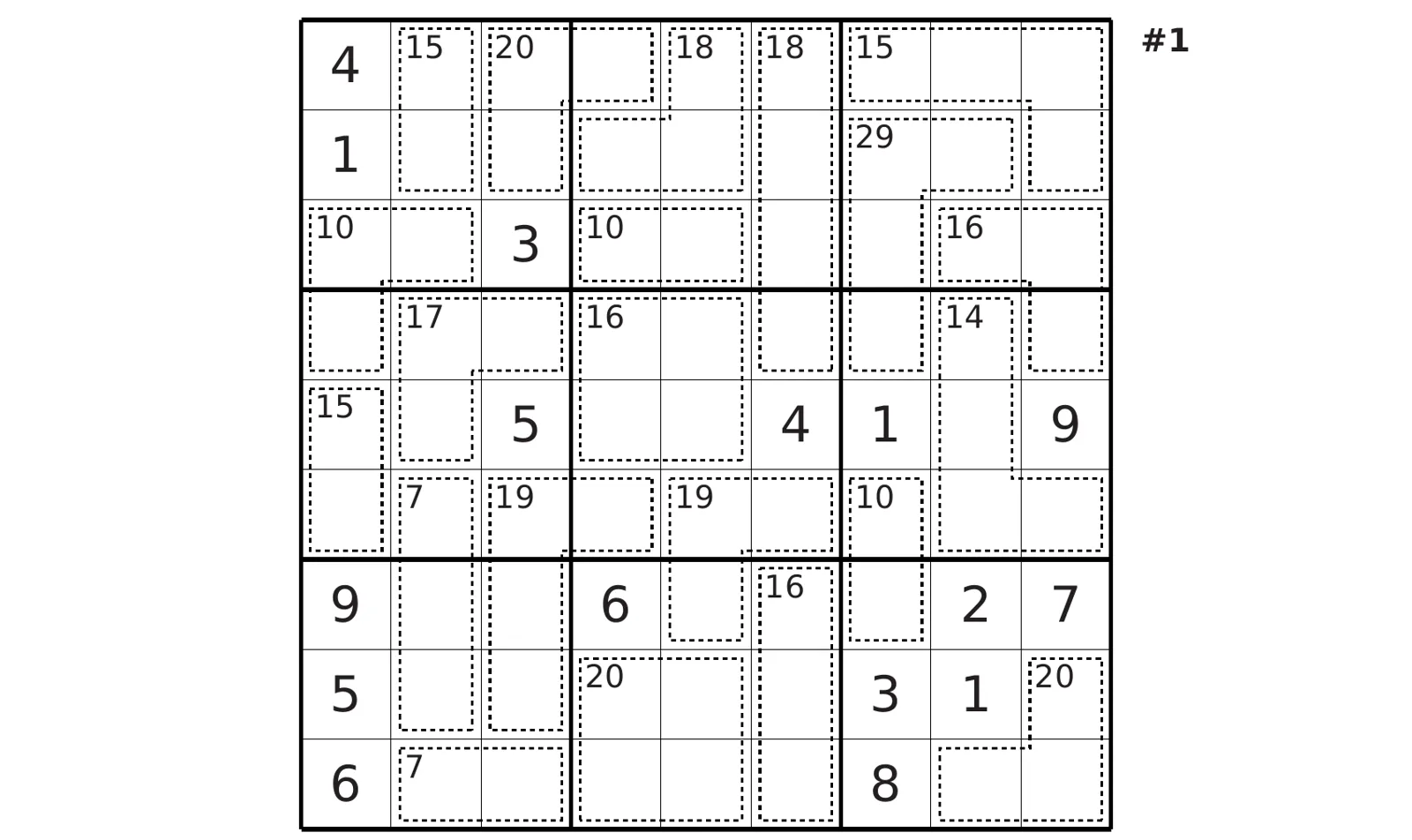
- 150 easy puzzles with starting digits, from the easiest to the hardest. Each one has exactly one solution and can be solved by logic alone.
- A starter guide: the rules, three basic techniques, the rule of 45 and two moves for the trickier moments – everything you need for the whole book.
- Cage-sum tables for two-, three- and four-cell cages. No need to work out in your head how many ways there are to make 14 from three digits.
- Large print: 8.5 × 11 in pages, two grids per page, 14 mm cells, 14 pt cage sums and 21 pt starting digits. There's room for pencil notes.
- Complete solutions at the back of the book.
It makes a good gift for someone who knows Sudoku inside out and wants something new – or a treat for yourself on long winter evenings.