What is Kakuro? The crossword made of numbers
If you like Sudoku, there's a good chance you'll like Kakuro too, and you don't need to be good at maths.
At first glance a Kakuro grid looks like a crossword: black and white squares, numbers in the corners, rows and columns that cross. But there are no words to guess. Every clue is a sum, and every answer is a digit.
The rules
A Kakuro puzzle has three rules:
- Write a digit from 1 to 9 in every white cell.
- The number in a black clue cell tells you the sum of the white cells next to it. The number below the diagonal is for the cells under it (going down), and the number above the diagonal is for the cells to its right (going across). A row of white cells like this is called a run.
- No digit may repeat within a run.
That's all. Each puzzle has exactly one solution, and you get there by logic, not by guessing.
Why it's easier than it looks
The arithmetic never goes beyond adding up small numbers. The fun is in noticing that some sums can only be made in one way.
Take a run of two cells with the clue 4. The only digits that add up to 4 are 1 + 3, because 2 + 2 would repeat a digit. You don't know yet which cell is the 1 and which is the 3, but the run that crosses it will tell you.
A few more of these "only one way" sums:
- two cells adding up to 3: always 1 and 2
- two cells adding up to 17: always 8 and 9
- three cells adding up to 6: always 1, 2 and 3
- three cells adding up to 24: always 7, 8 and 9
Once you know a handful of these, you start every puzzle with a few safe moves, and each new digit gives you a clue about the next one.
Where Kakuro comes from
Despite the Japanese name, Kakuro started out in North America. Puzzles of this kind were printed in Dell puzzle magazines in the US from around 1950, under the name Cross Sums. The idea is usually credited to Jacob E. Funk, a Canadian who wrote puzzles for Dell.
In 1980 Maki Kaji, the founder of the Japanese puzzle publisher Nikoli, came across these puzzles and brought them to Japan. There they were called kasan kurosu, "addition cross", which was soon shortened to Kakuro. The puzzle became Nikoli's most popular one for over a decade, until another number puzzle overtook it: Sudoku.
In the mid-2000s, after the Sudoku boom, Kakuro made its way into British newspapers and from there to puzzle books around the world. So it has travelled from America to Japan and back, and picked up a new name on the way.
How to start
A full-size Kakuro can look scary to a beginner, with long runs and big sums everywhere. The best way in is the same as with Sudoku: start with small grids, learn the "only one way" sums, and move up slowly.
That's how we built Kakuro Puzzle Book for Beginners:
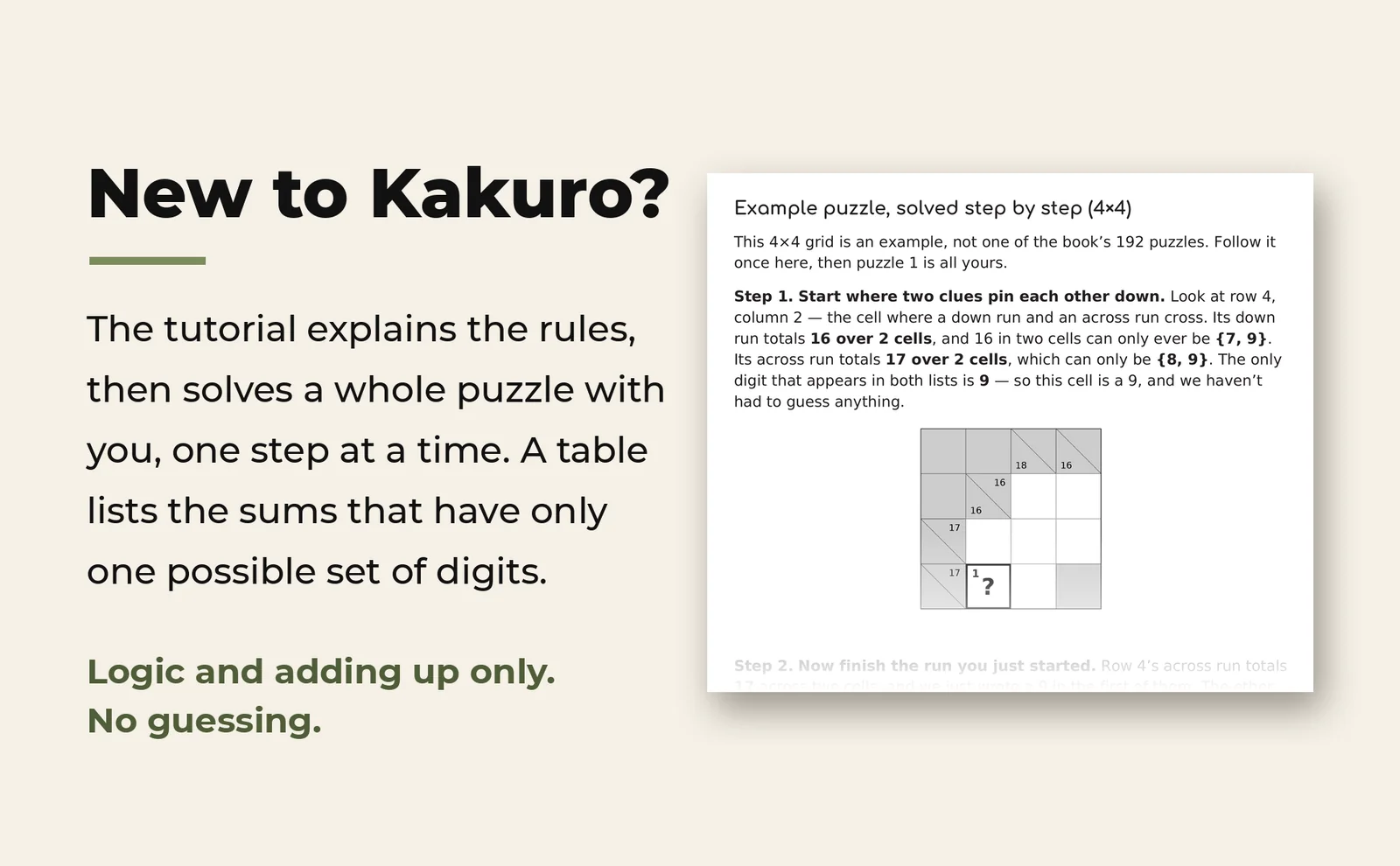
- A step-by-step tutorial first. Before puzzle 1, the book solves a complete example puzzle with you, one move at a time, and explains why each digit goes where it goes.
- A reference table of the sums that can only be made one way, so you don't have to work them out yourself.
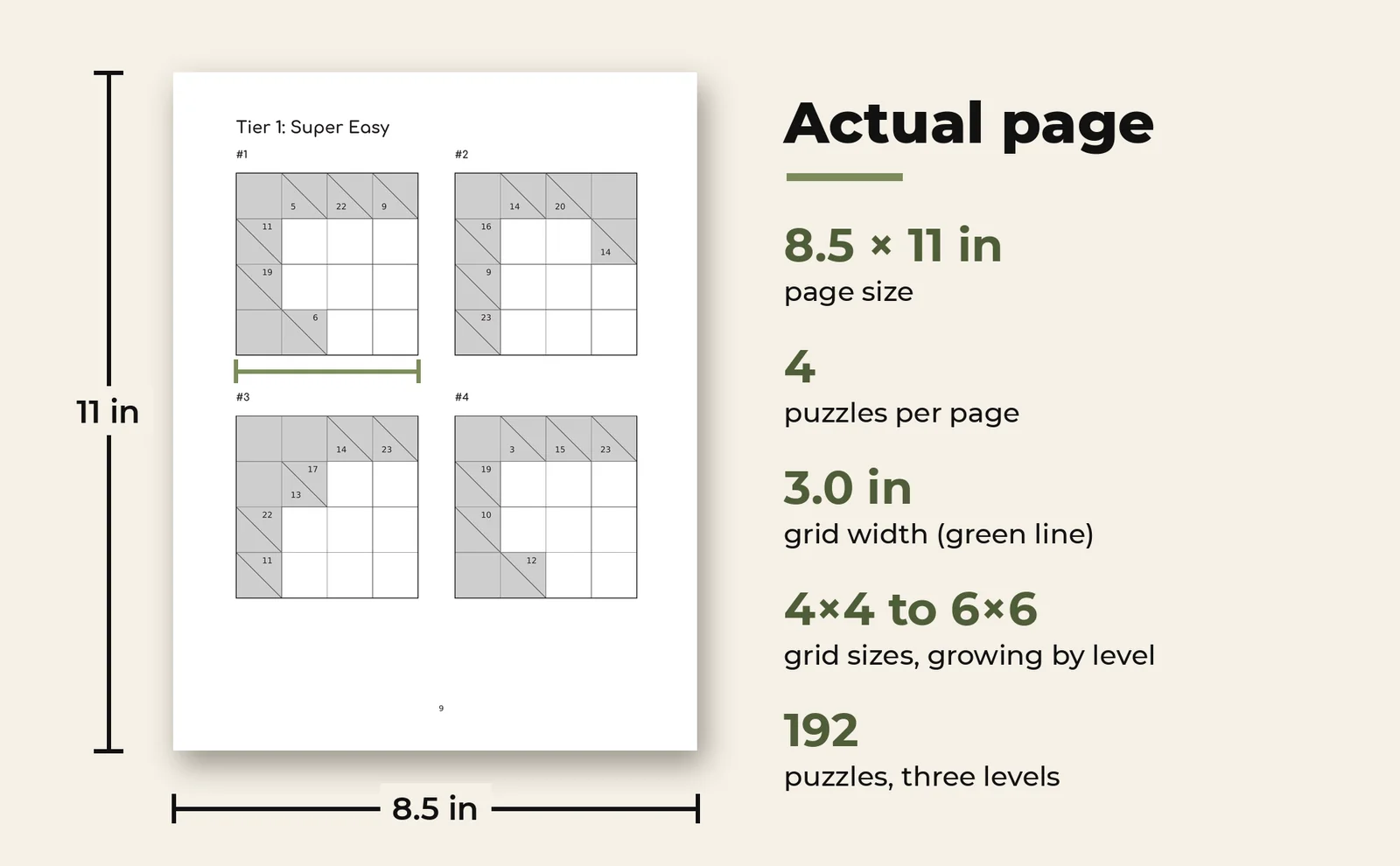
- 192 puzzles in three levels, with the grids growing as you get better: 32 Super Easy (4×4), 64 Easy (5×5) and 96 Normal (6×6).
- Big pages and plenty of room. Four puzzles on each 8.5 × 11 in page, every grid 3 in wide, so there's space for your pencil.
- A full answer key at the back of the book.
If you've enjoyed Sudoku for years and fancy something new, or you're looking for a gift for a puzzle lover, this is a gentle way to try Kakuro. Grab a pencil (and an eraser) and start with puzzle 1.
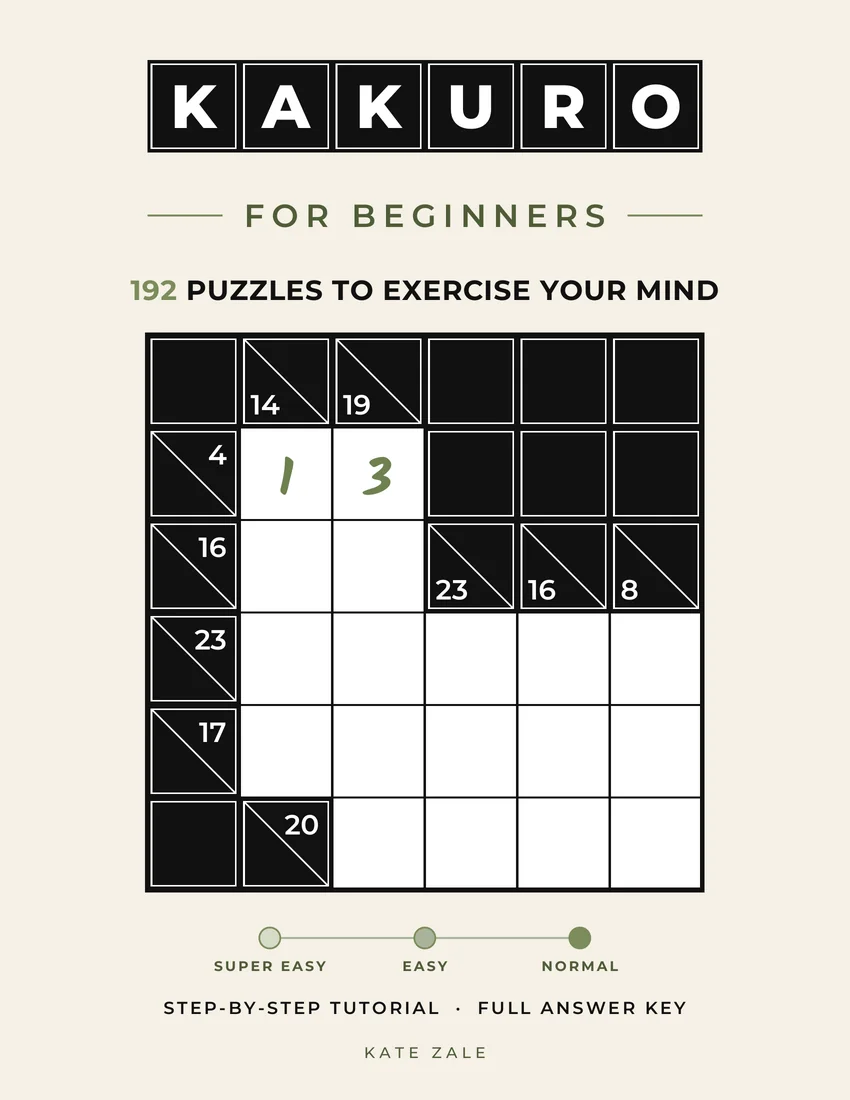
Kakuro Puzzle Book for Beginners
192 cross-sum puzzles, super easy to normal · Adults