Large Print Sudoku – big, clear puzzles at the right level for you
Love Sudoku but tired of squinting at newspaper grids? This series is for you.
Ten or twenty minutes of Sudoku a day is a nice habit: you only need a pencil and a grid. The trouble is that many puzzle books are printed as if everyone had perfect eyesight. The digits are tiny, there are four or six grids on a page, and there's hardly any room for notes.
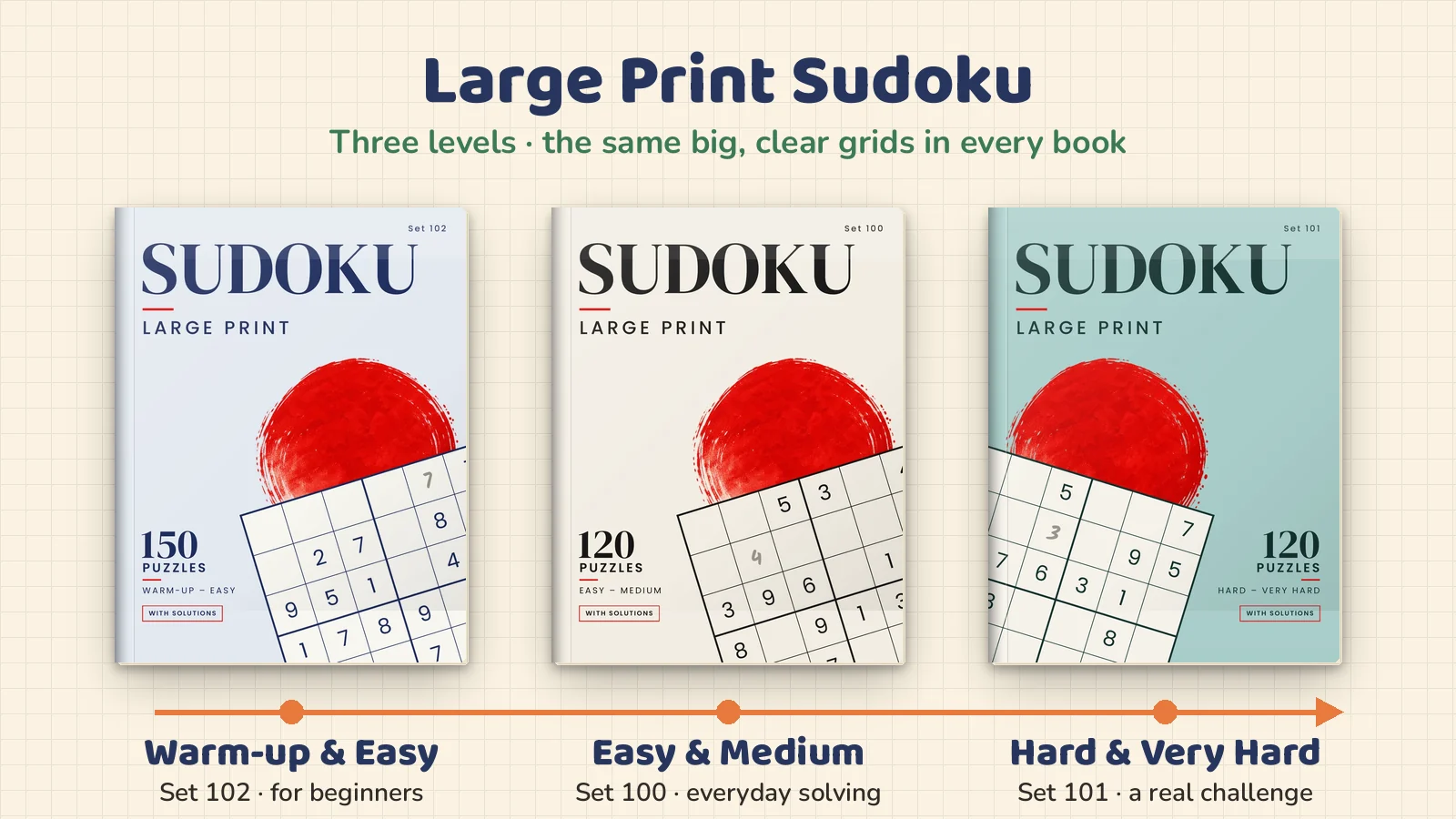
We wanted something easier on the eyes, so we made Large Print Sudoku: three books with the same big layout, each at a different level.
How large is "large print"?
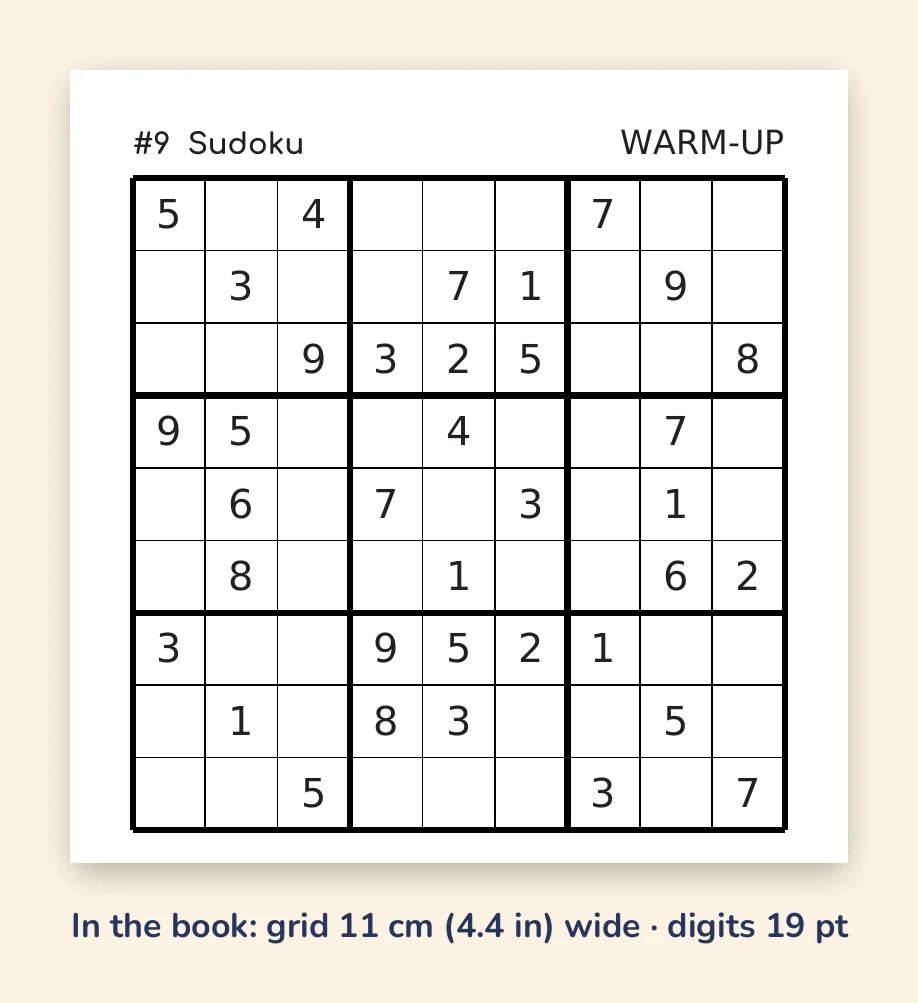
Every publisher means something different by it, so here are our numbers:
- The digits in the grids are 19 pt. Normal book text is around 10–12 pt, and large print usually starts at 16 pt.
- Each grid is 11 cm (4.4 in) wide, so a single cell is a bit over 1.2 cm (half an inch).
- There are two puzzles per page. The pages are 8.5 × 11 in, close to A4, so each grid has plenty of space around it.
- The 3×3 boxes have thick borders, and the lines between cells are thin.
- The cells are big enough to pencil in small candidate digits when a puzzle gets harder.
- The introduction is printed at 16 pt, and the digits in the solutions at the back are just over 15 pt.
- Each puzzle has exactly one solution and can be solved without guessing. No puzzle appears twice in the same book.
Who it's for
We had in mind people who struggle with small print: those who need glasses to read the paper, whose eyesight has got worse over the years, or whose eyes are simply tired in the evening. With bigger digits you're less likely to mistake a 3 for an 8, and you can play longer before your eyes get tired.
Some people also just like a page that isn't crowded.
Large print helps if small text is hard to read, but it won't replace a magnifier for someone with very poor sight. If you use one, these books work well with it.
Choosing your level
A puzzle that's too easy gets boring, and one that's too hard is frustrating. That's why the series has three books instead of one that goes from easy to very hard.
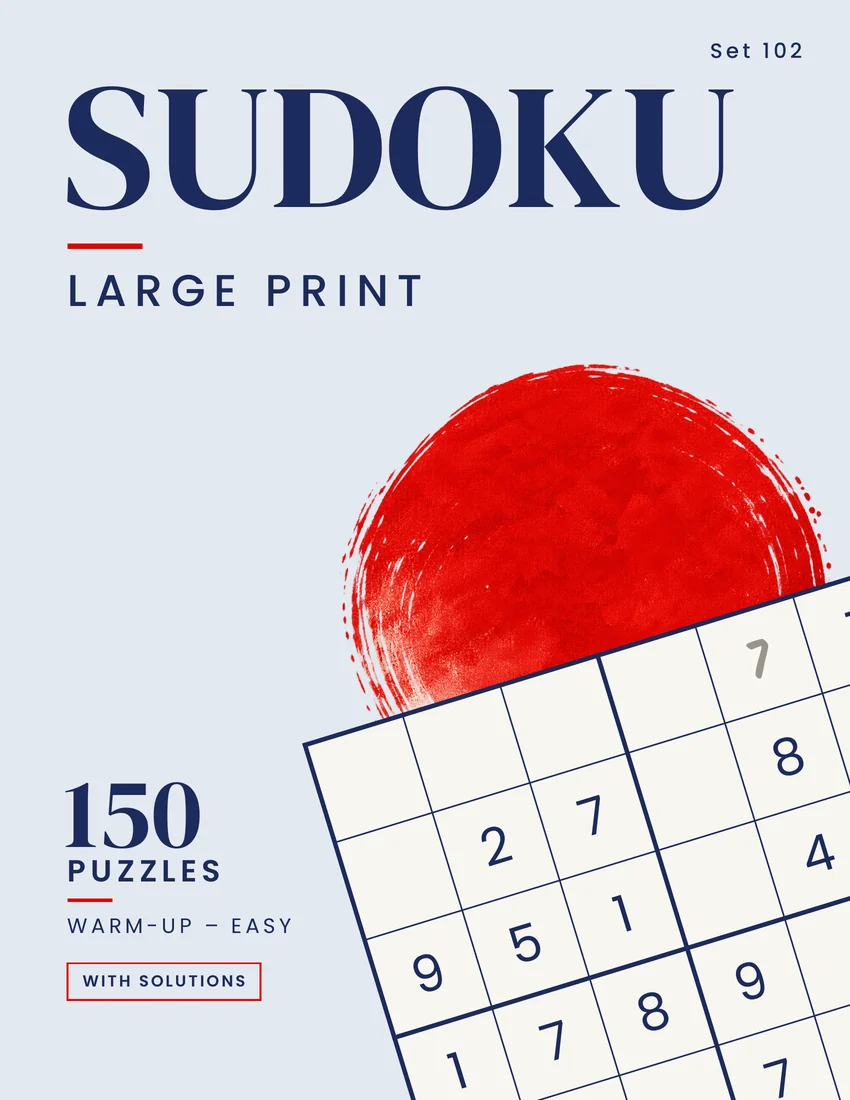
Set 102: Warm-up and Easy (150 puzzles)
Start here if you've never played Sudoku, haven't played for years, or want something gentle for every day.
The first 60 puzzles are a warm-up. Each one can be solved with a single method: you look at a cell and check which digit is missing. From puzzle 61 you'll also need a second method. The introduction explains both step by step and gives a few tips for when you get stuck.
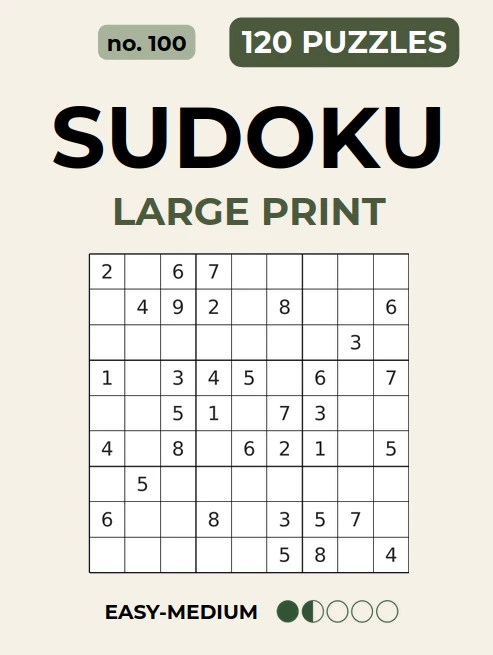
Set 100: Easy and Medium (120 puzzles)
This one is for you if you know the rules and can finish an easy puzzle, but would like a bit more to think about.
Every thirty puzzles there are two fewer starting digits, so the puzzles slowly get harder. The introduction explains three basic methods, and they are enough for the whole book.
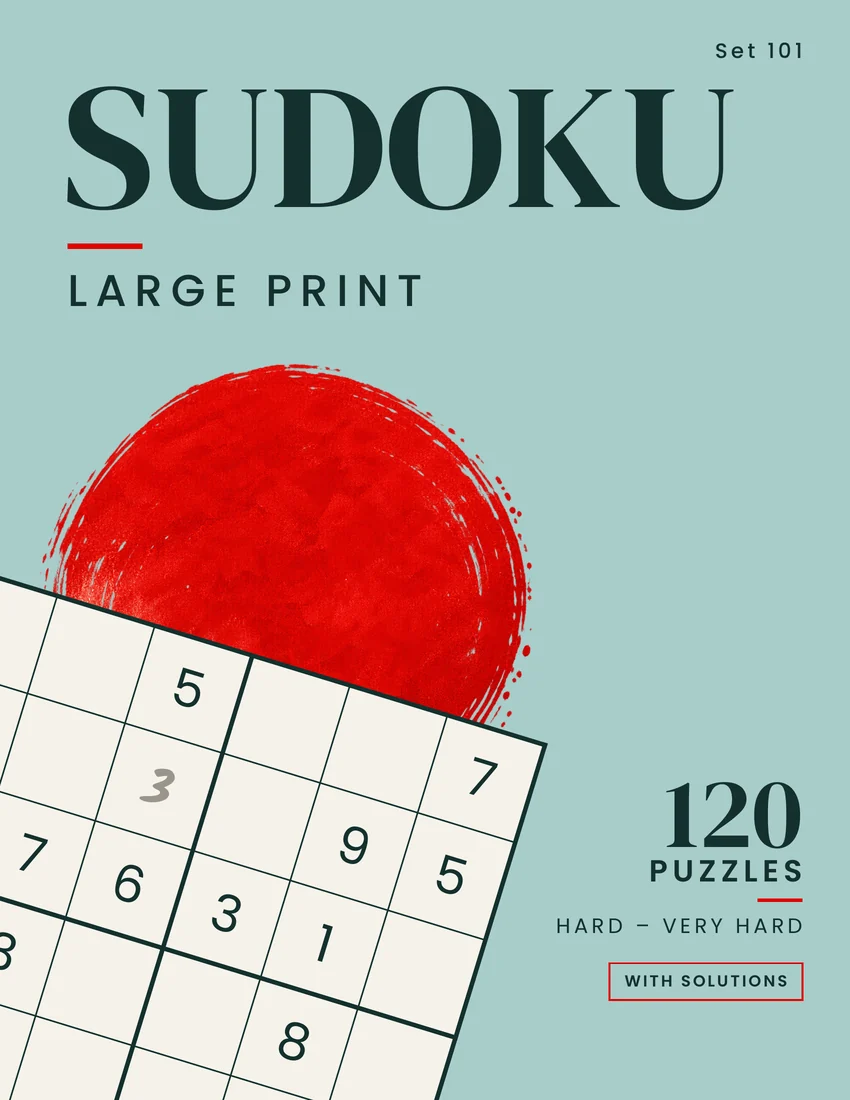
Set 101: Hard and Very Hard (120 puzzles)
For people who find easy puzzles boring and want a real challenge, but in big print.
There are no beginner puzzles here. Numbers 1–60 are hard and 61–120 are very hard. The introduction covers the advanced techniques you'll need: pairs and triples, X-Wing, Swordfish and XY-Wing.
Which one should I pick?
- If you've never solved a Sudoku, or it's been years, start with Set 102.
- If you can finish a newspaper puzzle marked "easy", try Set 100.
- If "medium" puzzles don't give you much trouble, go for Set 101.
In Sets 101 and 102 the level is printed above each grid.
Where to buy
If your mum, dad or grandparent likes puzzles, any of these books makes a good gift. All three books are on Amazon in the US, UK, Canada, Australia and across Europe. On your local Amazon, search for "Zalka Books", or use the links to amazon.com: